
A roofer slips off a ladder and breaks a wrist. Nobody argues about where it happened. There was a fall, a witness, a ride to the clinic, and a date on the paperwork. Now take a warehouse worker who develops a stubborn cough after eleven years of breathing dust and fumes. No single afternoon caused it, and no coworker saw it happen. The illness is real, but the link to the job has to be built from scratch, which can make negotiating lump-sum resolutions more complicated.
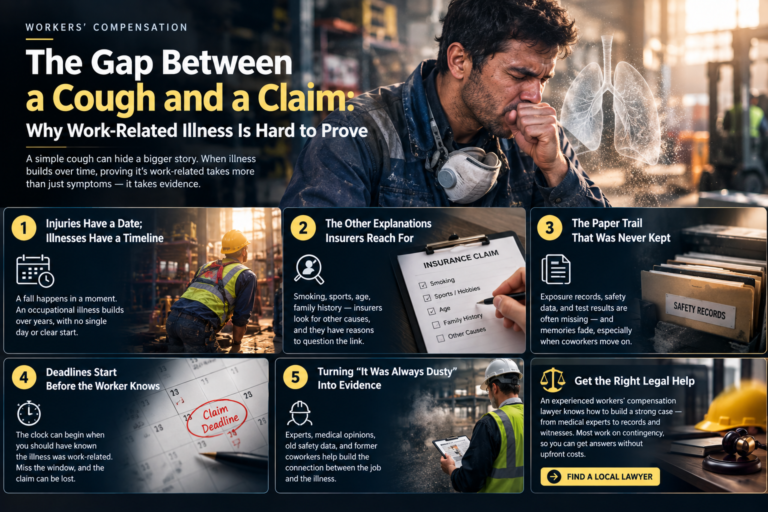
Injuries have a date; illnesses have a timeline
Workers’ compensation systems were originally built around accidents. A claim for an occupational disease asks the system to do something different: show that years of ordinary working conditions slowly damaged someone’s body. Hearing loss, asthma, repetitive strain, skin conditions and certain cancers all fall into this group. The worker usually notices symptoms long before anyone mentions work as the cause, and by then the exposure is often a decade old.
The other explanations insurers reach for
Once a claim lands, the insurer starts looking for another culprit. A worker with lung disease gets asked about smoking. A worker with a bad back gets asked about weekend sports, age, and weight. Someone with a rare illness gets asked about family history. Each question is fair on its own, and each gives the insurer a reason to say the job was not the main cause.
The legal standard varies, but most systems do not require the job to be the only cause. A significant contribution is usually enough. Getting a medical professional to say that clearly, in writing, is where many claims stall. Doctors treat patients; they rarely write opinions on workplace causation unless someone asks precisely the right question.
The paper trail that was never kept
Exposure is hard to prove after the fact. The worker needs records of which chemicals were used, how long the shifts ran, whether the ventilation worked, whether anyone measured the air. Many employers never tested. Others did, and the results sit in a filing cabinet nobody has opened since the last renovation. Some companies have closed entirely. A memory of “it was always dusty in there” does not carry much weight against a safety data sheet calling the product harmless.
Coworkers help when they are findable. People change jobs, move away, and get nervous about testifying against a current employer. A claim that depended on a former colleague’s statement can fall apart when that colleague stops returning calls.
Deadlines that start before the worker knows
In many systems the clock starts when the worker knew, or reasonably should have known, that the illness was connected to work. Insurers sometimes argue the worker should have known years earlier, pointing to an old doctor visit where a cough was mentioned. A person who spent two years assuming it was a lingering cold suddenly faces an argument that the deadline passed long ago.
Fun fact: Back in 1700, a physician named Bernardino Ramazzini published one of the first major books on diseases of workers. He urged doctors to add one question to every examination: what work does the patient do? Plenty of clinics still skip it, which is part of why so many claims start with a medical file that never mentions the job.
Turning “It Was Always Dusty” Into Evidence
Occupational disease files are where experienced workers’ compensation lawyers do their best work, and anyone who has watched one build such a case tends to come away impressed. They know which specialists write causation opinions that hold up when an insurer’s doctor disagrees. They know how to ask a treating physician the right question, so the answer is “this exposure contributed to the condition” instead of a shrug. They track down old safety data sheets, hire industrial hygienists to reconstruct what the air was like, and find former coworkers before memories fade. If you’re not sure where to start, it helps to see who is actually close to you, so take a look at what’s right below:
They also read the deadline rules closely. A lawyer who reviews the timeline early will often spot that the clock is shorter than the worker assumed, and file before it runs out. Workers who go it alone sometimes learn about the deadline only when the denial letter arrives. Lawyers who handle these claims regularly also expect the smoking question, the age argument, and the request for ten years of medical records, and they prepare answers before the questions come.
The strongest occupational illness claims usually share one trait: someone started documenting early. A worker who writes down what they handled, how long, and who else was in the room has already done half the work. Dates, product names, a photo of a label, a note on when symptoms began. None of it feels like evidence at the time, and all of it matters a year later.