


Vegamour has become a recognizable name in the hair-wellness market, particularly among consumers looking for products aimed at thinning hair and shedding. At the same time, searches for the Vegamour lawsuit have grown as people encounter online complaints, discussions about product effectiveness, and questions surrounding the company’s marketing.
Many searchers want to know whether Vegamour has actually been sued over hair loss, whether GRO Hair Serum has been linked to a class action, and whether dissatisfied customers could receive compensation. These questions require an important distinction between consumer complaints, advertising scrutiny, and an actual product-liability lawsuit.
Public records show that Vegamour has faced legal proceedings, including website-accessibility litigation, as well as advertising scrutiny. However, that does not establish that a broad hair-loss class action against Vegamour exists. Below, we separate documented legal developments from consumer reports and online speculation.
Why People Are Searching for the Vegamour Lawsuit
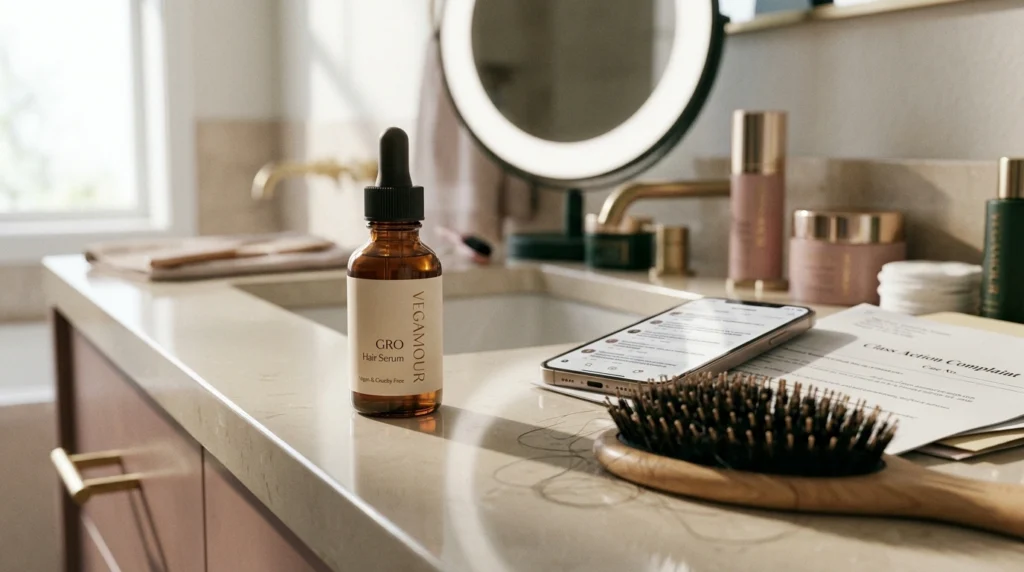
Interest in the Vegamour lawsuit appears to come from several different issues being grouped together online. Some consumers report that hair products did not deliver the results they expected. Others discuss shedding, scalp reactions, pricing, or dissatisfaction after using the products.
There is also a documented legal history involving Vegamour. For example, a federal complaint filed in Connecticut in 2020 alleged accessibility problems with the company’s website under the Americans with Disabilities Act. Another accessibility complaint involving Vegamour was filed in New York in 2024.
Vegamour has also attracted advertising scrutiny. The National Advertising Division, part of BBB National Programs, reviewed advertising involving the GRO Ageless Anti-Gray Hair Serum. According to an NAD case digest, Vegamour voluntarily discontinued certain advertising claims examined during that matter.
These developments can easily become mixed together with hair-loss complaints in search results and social-media conversations.
The key distinction is that a consumer complaint, advertising inquiry, and lawsuit are not interchangeable legal events. Likewise, evidence that a company has been sued for one issue does not prove allegations concerning an unrelated product.
Understanding Vegamour and Its Hair Care Products
Vegamour is a hair-wellness company offering products designed around concerns such as thinning, shedding, scalp health, hair density, and appearance. Its product catalog has included serums, shampoos, conditioners, supplements, and products targeting gray hair.
The GRO Hair Serum is one of the brand’s better-known products. Consumers typically encounter it while searching for nonprescription approaches to fuller-looking or healthier hair.
That positioning is important when considering lawsuit searches. Hair loss is influenced by many variables, including genetics, hormonal changes, nutritional deficiencies, stress, illness, medications, aging, styling practices, and underlying medical conditions.
As a result, a consumer noticing increased shedding after beginning a cosmetic product does not by itself prove that the product caused the shedding. Establishing causation in a product-liability case generally requires considerably more evidence.
Has There Been a Verified Vegamour Lawsuit?
Yes, Vegamour has been named in actual lawsuits, but the nature of those lawsuits matters.
One documented case was filed by Barbara Blejewski against Vegamour, Inc. in federal court in Connecticut in August 2020. The complaint concerned alleged barriers preventing people with disabilities from properly accessing the company’s website. It was therefore an ADA website-accessibility case, not a lawsuit alleging that Vegamour hair serum caused widespread hair loss.
A separate complaint filed by Jacqueline Fernandez against Vegamour in New York in May 2024 also concerned alleged digital-accessibility issues.
This distinction matters for consumers searching specifically for a Vegamour hair-loss lawsuit.
| Question | Current Picture |
|---|---|
| Has Vegamour been sued? | Yes |
| Have website-accessibility claims been filed? | Yes |
| Has Vegamour faced advertising scrutiny? | Yes |
| Do online hair-loss complaints exist? | Yes |
| Do complaints prove product liability? | No |
| Is a major hair-loss class action established by these facts? | No |
Consumers should therefore be cautious with websites or social posts that describe every complaint surrounding Vegamour as part of one large product-liability case.
Why Some Customers Report Hair Loss After Using Vegamour
Hair shedding reported after starting a new product can understandably cause concern. Yet timing alone does not establish causation.
Some online reviewers have attributed increased shedding, changes in texture, irritation, or disappointing results to products they used. Other consumers describe positive experiences or believe their hair appeared fuller.
Several factors can complicate these reports.
Natural Hair Growth Cycle
Human hair continuously moves through growth, transition, resting, and shedding phases. Losing some hair is therefore part of normal biology.
A person who begins closely monitoring their hair after purchasing an expensive growth product may also become more aware of shedding that was already occurring.
This does not mean every complaint should be dismissed. Instead, it demonstrates why medical and legal causation cannot usually be determined from a before-and-after observation alone.
In a product-liability dispute, investigators may need to consider the consumer’s medical history, timeline of product use, other treatments, laboratory findings, dermatological assessment, and whether symptoms improved after discontinuation.
Existing Hair Conditions
People buying hair-growth products often already have thinning or shedding before using them. That creates an obvious causation problem.
Androgenetic alopecia, alopecia areata, telogen effluvium, hormonal changes, postpartum shedding, thyroid disorders, nutritional deficiencies, and other conditions can contribute to hair loss.
If an underlying condition continues progressing while a consumer uses a cosmetic serum, the worsening hair loss may coincide with the product without necessarily being caused by it.
Anyone experiencing sudden, severe, patchy, painful, or persistent hair loss should consider seeking medical evaluation rather than relying solely on cosmetic products or online reviews.
Temporary Shedding
Hair shedding can fluctuate naturally. Stress, illness, rapid weight changes, dietary changes, hormonal shifts, and other events may affect the hair cycle months after the original trigger.
This delayed response makes personal timelines difficult to interpret.
A person may begin using a serum shortly before shedding becomes noticeable and reasonably suspect the new product. Medically, however, another earlier event could potentially be responsible.
That uncertainty is one reason individual reports cannot establish that a particular product causes shedding across a broader population.
Allergic Reactions
Cosmetic and personal-care products can sometimes cause irritation or sensitivity in individual users. A reaction may involve redness, itching, burning, dryness, swelling, or scalp discomfort.
A reaction does not necessarily mean a product is inherently defective. Individual sensitivities vary considerably.
Consumers who believe they are experiencing a reaction should stop relying on online speculation and seek appropriate professional advice when symptoms are significant. Keeping photographs, purchase receipts, product packaging, ingredient information, and medical records may also be useful if a serious adverse reaction later becomes the subject of a complaint.
What Are Consumers Saying on Reddit?
Reddit discussions provide a useful view of consumer sentiment, but they should not be treated as clinical studies or verified evidence.
Discussions in hair-loss communities show sharply different experiences with Vegamour. Some users say they noticed improvements, while others report little benefit, continued thinning, or dissatisfaction after using the products for several months.
That range of experiences is important when interpreting the online conversation.
Positive Experiences
Some consumers report seeing new baby hairs, improved appearance, reduced shedding, or fuller-looking hair after incorporating Vegamour into their routines.
Similar positive experiences appear outside Reddit in beauty communities and product reviews.
However, individual testimonials cannot determine whether the product itself caused the improvement. Hair routines often involve several simultaneous changes, such as supplements, prescription or over-the-counter treatments, dietary adjustments, new shampoos, or changes in styling practices.
Positive reviews are therefore useful for understanding customer experience but are not equivalent to controlled clinical evidence.
Neutral Experiences
Another group reports little or no noticeable change.
These consumers may use the product for weeks or months without experiencing the improvement they expected. For them, the main complaint may be value rather than physical harm.
This distinction has legal significance.
A cosmetic product failing to meet an individual’s expectations does not automatically create a viable lawsuit. A stronger consumer-protection claim would normally require something more, such as a materially misleading representation that influenced the purchase.
Negative Experiences
Some Reddit users have been considerably more critical. Posts in hair-loss communities describe experiences involving continued shedding, thinner-feeling hair, disappointment with results, or the belief that the products were not worth their cost.
These reports help explain why people search for lawsuit information.
They remain anecdotal, however. Reddit does not independently verify the user’s medical history, how a product was applied, whether other treatments were being used, or what caused a reported change.
Negative reviews should consequently be described as consumer reports, not proof that Vegamour products caused hair loss.
Examining Claims About the GRO Hair Serum
GRO Hair Serum occupies a central position in Vegamour’s hair-wellness lineup and is frequently discussed by consumers dealing with thinning or shedding.
The legal question surrounding any marketing claim is not simply whether every customer obtains the expected result. Advertising disputes generally focus on what a reasonable consumer would understand the claim to mean and whether the advertiser possesses appropriate substantiation.
Hair-growth language requires particular care because consumers may interpret terms such as “growth,” “density,” “thicker,” or “fuller” differently.
There is also an important distinction between improving the appearance of hair, supporting a healthy scalp environment, reducing breakage, and medically treating an underlying hair-loss disorder.
Consumers evaluating GRO Hair Serum should therefore look beyond testimonials and consider the precise wording of product claims, available studies, study design, ingredients, expected timeframe, and limitations.
What Ingredients Are Included in Vegamour Products?
Vegamour formulations differ across its product lines, so there is no single ingredient list that accurately describes every product.
The brand has marketed formulas containing plant-derived ingredients and other compounds aimed at scalp or hair wellness. Different GRO, GRO+, shampoo, conditioner, gray-hair, and styling products may use substantially different formulations.
Consumers concerned about sensitivity should therefore check the ingredient label for the exact product they are using rather than relying on a general online ingredient list.
Ingredient presence also should not be confused with proof of effectiveness. Whether a formula produces a meaningful result depends on factors including concentration, delivery method, frequency of use, study quality, and the underlying cause of the consumer’s hair concerns.
Anyone with known allergies or a history of scalp reactions may want to discuss specific ingredients with an appropriate healthcare professional.
Can Marketing Claims Lead to Consumer Lawsuits?
Yes. Marketing practices can lead to litigation when consumers allege that advertising was materially false or misleading and caused them economic harm.
However, advertising disputes do not always become lawsuits.
Vegamour provides a useful example. BBB National Programs’ National Advertising Division examined certain advertising surrounding the GRO Ageless Anti-Gray Hair Serum. The matter involved social-media posts connected with reviews, and the NAD case digest states that Vegamour voluntarily discontinued the advertising claims at issue.
An NAD proceeding is an advertising self-regulatory process, not a court judgment finding a company legally liable.
False Advertising
False-advertising cases generally examine whether consumers received materially inaccurate information about a product.
A plaintiff may argue that they purchased something because of a specific representation that was false or inadequately supported.
Whether such a claim succeeds depends on the wording of the advertisement, applicable state or federal law, evidence supporting the representation, what the consumer relied upon, and whether measurable harm resulted.
An unfavorable customer review alone generally does not establish false advertising.
Misleading Performance Claims
Performance claims can create legal concerns when advertising communicates a level of effectiveness that available evidence cannot substantiate.
Hair-wellness products present a particularly nuanced example.
Statements about stronger-looking, thicker-looking, or healthier hair can communicate something different from claims that a product treats a medical cause of hair loss or reliably regrows lost hair.
Context therefore matters. Courts and advertising regulators may consider the full advertisement rather than evaluating isolated words.
Product Representation
Product representation extends beyond performance claims.
Consumers may make allegations concerning ingredients, safety, testing, endorsements, subscription terms, pricing, refunds, or other information that influenced their purchasing decision.
For such concerns to become viable legal claims, plaintiffs generally need an applicable legal theory and supporting evidence.
The existence of online criticism does not itself establish that a company’s representations violated consumer-protection law.
How Cosmetic Product Lawsuits Typically Develop
Cosmetic-product litigation usually develops through a sequence of events rather than immediately becoming a class action.
Consumers first report an alleged problem. Attorneys, regulators, manufacturers, medical professionals, or independent researchers may then examine whether the reports indicate a broader pattern.
Only some disputes progress to litigation.
Consumer Complaints
The process often starts with individual reports.
Consumers may contact the manufacturer, retailer, a regulator, or an attorney after experiencing an alleged reaction or believing a product was misrepresented.
Useful documentation can include receipts, order confirmations, photographs, packaging, lot numbers, communications with customer service, and medical records.
Multiple similar complaints can attract attention, but volume alone does not prove a common cause.
Investigation
Attorneys considering product litigation generally investigate whether the factual and legal basis is strong enough to pursue.
Questions may include whether consumers experienced similar injuries, whether the same formulation was involved, whether the manufacturer knew about a potential issue, and whether scientific evidence supports causation.
Investigators may also review marketing materials and internal documents if they later become obtainable through litigation.
Filing of Lawsuits
A lawsuit begins when a plaintiff files a complaint asserting legally recognized causes of action.
Depending on the allegations, these could potentially involve product liability, breach of warranty, false advertising, deceptive trade practices, or other state-law claims.
Filing a complaint does not mean the allegations have been proven.
The defendant may dispute the allegations, seek dismissal, raise defenses, or challenge whether the plaintiff has sufficient evidence.
Discovery
If litigation proceeds, discovery allows the parties to request relevant evidence from each other.
This stage may involve documents, emails, corporate records, scientific evidence, depositions, expert testimony, testing information, and consumer records.
Discovery can become especially important in product cases because causation may require scientific and medical analysis.
Evidence uncovered during this process can strengthen, weaken, or substantially change the case.
Settlement or Trial
Many civil cases resolve before trial, but settlement is never guaranteed.
A settlement can involve monetary payments, business-practice changes, refunds, injunctive relief, or other terms without an admission of wrongdoing.
If the parties do not settle and the case survives earlier challenges, it may proceed toward trial.
A verdict would then depend on the evidence presented and the applicable legal standards.
Does Hair Loss Automatically Mean a Product Is Defective?
No. Hair loss occurring while someone uses a product does not automatically establish that the product is defective.
Product-liability cases generally require evidence connecting the alleged defect with the injury.
That distinction is particularly important for hair-loss products because the target customer may already be experiencing shedding before purchasing the product.
A proper investigation could examine the timing and pattern of hair loss, underlying diagnoses, other products or medications, changes in diet or health, ingredient exposure, dermatological findings, and whether similar reactions occurred among other consumers.
A temporal relationship can be relevant evidence, but “I used the product and then experienced hair loss” is not necessarily the same as proving “the product caused my hair loss.”
Vegamour Reviews Across Consumer Platforms
Vegamour reviews vary considerably depending on the product and platform.
Positive reviewers sometimes describe softer hair, improved volume, reduced shedding, or visible new growth. Neutral reviewers frequently report that they noticed little difference despite consistent use.
Negative reviewers may complain about price, effectiveness, customer service, subscription experiences, scalp reactions, or continued hair loss.
This mixed picture is common with beauty and wellness products, particularly when consumers begin with different underlying causes of thinning.
Reviews are useful for identifying recurring themes. They are much less reliable for determining medical causation or legal liability.
Consumers researching Vegamour should therefore distinguish among verified purchases, sponsored or incentivized content, independent reviews, anecdotal social-media reports, clinical evidence, and official legal or regulatory records.
Comparing Vegamour With Other Hair Growth Brands
Vegamour is often compared with other brands marketed toward people concerned about thinning hair. Nutrafol is one of the most common comparisons, although the two companies do not necessarily offer identical types of products.
| Feature | Vegamour | Nutrafol |
|---|---|---|
| Main category | Hair wellness and topical products | Hair wellness supplements and related products |
| Common format | Serums, shampoo, conditioner and related care | Oral supplements plus hair-care products |
| Consumer focus | Thinning, shedding and hair appearance | Hair thinning and wellness factors |
| Treatment approach | Varies by product | Varies by product |
| Results | Individual results differ | Individual results differ |
Consumers should compare the actual products rather than assuming two brands are interchangeable.
Vegamour
Vegamour’s lineup includes topical serums and broader hair-care products. This can appeal to consumers who want to incorporate a serum, shampoo, conditioner, or related product into an existing routine.
The company emphasizes hair wellness rather than positioning every product as a pharmaceutical treatment.
Consumers experiencing unexplained hair loss should nevertheless avoid assuming that a cosmetic routine addresses the underlying cause.
A dermatologist or other qualified professional may be able to identify whether the issue is genetic, hormonal, nutritional, inflammatory, medication-related, or connected with another condition.
Nutrafol
Nutrafol is particularly known for hair-wellness supplements, although it also sells complementary hair-care products.
That makes the comparison with Vegamour imperfect.
A topical serum and an oral supplement expose consumers to different ingredients through different routes and may carry different considerations.
Before taking supplements, consumers should consider potential interactions, existing medical conditions, pregnancy-related considerations, and other medications. Professional advice may be appropriate when these issues apply.
Is Vegamour Available Through Sephora and Other Retailers?
Vegamour products have been sold through the company’s own channels as well as major beauty retailers, including Sephora.
Retail availability can make products easier to purchase and gives consumers another source for product descriptions, ingredient information, customer reviews, and return policies.
However, retailer availability should not be interpreted as a legal or medical endorsement of every marketing claim associated with a product.
Consumers should evaluate the exact product they intend to purchase, particularly because formulations and product lines can change.
When investigating a possible adverse reaction, it is also useful to retain the packaging and identify exactly where and when the product was purchased. Order confirmations and receipts can help establish the product, purchase date, and seller if a complaint later needs to be documented.
Read: Cash App Class Action Lawsuit Settlement
Read: Chobani Yogurt Lawsuit
Read: Life360 Lawsuit 2026
Read: Isotonix Lawsuit
Read: QC Kinetix Lawsuit
Read: Anthony Mark Haskins Lawsuit QVC
Read: Manny Khoshbin Lawsuit
Frequently Asked Questions
Is there a lawsuit against Vegamour?
Yes. Vegamour has faced documented legal cases, including website-accessibility litigation. However, this does not confirm a major hair-loss class action.
Is there a Vegamour class action lawsuit over hair loss?
No verified major class action over Vegamour allegedly causing hair loss has been established based on the public information reviewed.
Has a Vegamour settlement been announced?
No confirmed settlement or compensation program related to a broad Vegamour hair-loss lawsuit has been announced.
Does Vegamour cause hair loss?
Some consumers report shedding, but individual complaints do not prove that Vegamour products caused their hair loss.
What are the main Vegamour complaints?
Common online complaints involve limited results, continued shedding, scalp reactions, pricing, and dissatisfaction with product performance.
Final Thoughts
Searches for the Vegamour lawsuit combine several separate issues: genuine litigation involving the company, advertising scrutiny, consumer dissatisfaction, Reddit discussions, and reports concerning hair shedding or product performance.
Those issues should not be collapsed into a single narrative.
Vegamour has faced documented legal proceedings, including website-accessibility litigation, and the company’s advertising has received scrutiny through the National Advertising Division. At the same time, consumer reports about hair loss or ineffective products do not independently prove that GRO Hair Serum is defective or that it caused a particular person’s shedding.
Consumers experiencing a significant reaction should document what happened, preserve product and purchase information, and consider appropriate medical or legal advice. Ultimately, legal liability depends on admissible evidence, applicable law, causation, and the outcome of actual court proceedings—not the number of complaints circulating online.