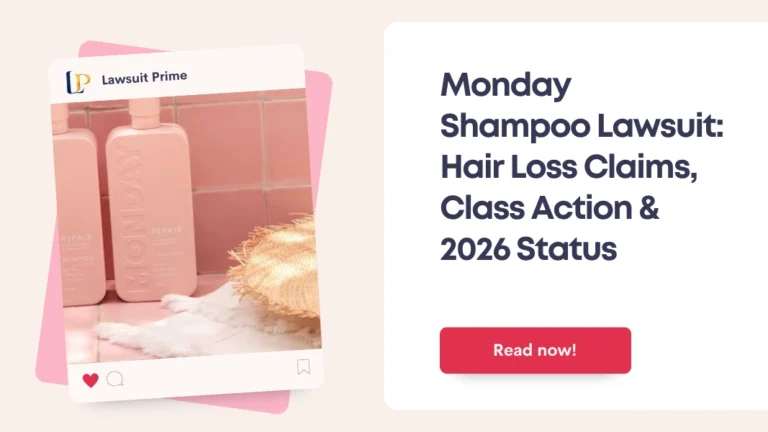

MONDAY Haircare has become a widely recognized drugstore haircare brand, helped by its distinctive pink packaging, affordable pricing, and strong social-media presence. At the same time, the Monday Shampoo Lawsuit search has gained attention as consumers look into reports involving hair shedding, dryness, scalp irritation, product build-up, and other concerns.
The legal picture needs an important distinction. There is a documented U.S. class action involving MONDAY Haircare, but the publicly reported 2025 case concerns allegedly deceptive or underfilled packaging—not allegations that the shampoo causes hair loss. Separately, hair-loss and damage claims continue to circulate through product reviews, TikTok, Reddit, and other consumer discussions.
This article separates those issues and examines the lawsuit status, settlement information, reported hair problems, ingredients, consumer experiences, and what someone experiencing a possible adverse reaction should consider.
Why Are People Searching for the Monday Shampoo Lawsuit?

Interest in a possible MONDAY shampoo lawsuit comes largely from the overlap between negative consumer experiences and an actual class action involving the brand.
For years, some consumers have posted online that they experienced unusual shedding, brittle or dry hair, scalp discomfort, build-up, or changes in hair texture after using MONDAY products. These reports have appeared on social media, retailer review pages, and haircare forums. They are personal accounts, however, and do not establish that MONDAY products caused those conditions.
The legal side adds another layer. A class action filed in California federal court in July 2025 alleges that certain MONDAY Haircare products were packaged in oversized containers that could mislead buyers about how much product they were receiving. The plaintiff reportedly purchased MONDAY Moisture + Hyaluronic Acid Shampoo before bringing the consumer-protection claims.
That case should not be confused with the online hair-loss controversy. The reported class action concerns packaging and product quantity. The widely discussed shedding and scalp complaints are a separate issue unless they become the subject of their own verified litigation.
Is There an Active Monday Shampoo Lawsuit?
Yes, there is a publicly reported class action involving MONDAY Haircare, but understanding what it alleges is critical.
According to a September 2025 report from Top Class Actions, plaintiff Silvia Garcia filed a lawsuit against Zuru LLC, doing business as Monday Haircare, in California federal court on July 25, 2025. The complaint alleges that MONDAY products were sold in deceptively oversized packaging containing significant empty space.
The lawsuit reportedly asserts consumer-protection claims related to packaging rather than claims that MONDAY shampoo causes hair loss.
| Question | Current Information |
|---|---|
| Has a MONDAY Haircare lawsuit been reported? | Yes |
| Type of reported case | Consumer class action |
| Main allegation | Deceptive oversized/underfilled packaging |
| Filed | July 25, 2025 |
| Hair-loss lawsuit confirmed by these sources? | No |
| Hair-loss complaints online? | Yes |
| Settlement announced? | No confirmed settlement identified |
This distinction matters for consumers searching phrases such as “Monday shampoo hair loss lawsuit.” Online complaints about shedding should not automatically be described as allegations in the packaging class action.
Has Any Settlement Been Announced?
No confirmed settlement of the reported MONDAY Haircare packaging class action was identified in the sources reviewed for this article as of August 2026.
That means consumers should be cautious about websites or social-media posts suggesting that a MONDAY shampoo settlement payment, payout amount, or claim form is already available. A lawsuit being filed does not automatically mean money will be distributed.
Class actions can end in several ways. A court may dismiss claims, the parties may litigate the dispute, the case may be resolved individually, or the parties may negotiate a class settlement that requires court approval.
If a class settlement eventually occurs, official notices would normally explain who qualifies, covered products or purchases, important deadlines, documentation requirements, and how claims should be submitted.
Consumers should therefore distinguish between a pending or reported lawsuit and an approved class action settlement. They are not the same thing.
What Hair Problems Have Consumers Reported?
The most prominent controversy surrounding MONDAY Haircare is not necessarily the packaging lawsuit. It is the volume of online discussion from consumers who believe their hair or scalp changed after using certain products.
Complaints appearing across consumer reviews and Reddit discussions include:
- Increased shedding or apparent hair loss
- Dry or brittle-feeling hair
- Scalp itching or irritation
- Residue and product build-up
- Tangling or frizz
- Hair breakage
- Changes in texture
These accounts should be treated as anecdotal reports. They can identify patterns worth investigating, but they cannot by themselves prove medical causation.
Increased Hair Shedding
Hair shedding is one of the most serious complaints associated with MONDAY in online discussions.
Some Reddit users have described seeing more strands than usual while washing or brushing their hair. Others say they noticed significant shedding only after using MONDAY products for several weeks or months.
Retail reviews show similarly mixed experiences. Target’s review summary for MONDAY Volume Shampoo notes positive comments about softness, shine, volume, and scent, while also identifying complaints involving hair loss, greasiness, and scalp irritation.
Timing alone does not establish causation. Hair shedding can result from numerous factors unrelated to shampoo, making an individualized medical assessment important when the change is substantial or persistent.
Dry Hair
Dryness and brittle texture are another recurring theme.
Some consumers describe their hair as initially feeling soft before becoming increasingly dry after continued use. Reviews published directly on MONDAY’s product pages also include negative accounts involving dryness, brittleness, frizz, tangling, and breakage.
Hair dryness can have many causes, including cleansing frequency, chemical processing, heat styling, environmental exposure, hair porosity, and incompatibility between a particular formula and an individual’s hair.
A negative reaction therefore does not necessarily mean a product is universally unsafe. Different hair types can respond very differently to the same formulation.
Scalp Irritation
Some users have reported itching, sensitivity, discomfort, or other scalp reactions.
A Reddit discussion about MONDAY products includes accounts describing itchy or irritated scalps alongside build-up and increased shedding. Other users in the same discussion report different experiences, illustrating how inconsistent individual responses can be.
Fragrance ingredients, preservatives, cleansing agents, or other components can potentially irritate certain individuals even when they are legally permitted cosmetic ingredients.
Persistent redness, burning, swelling, sores, or severe itching should be evaluated by an appropriate healthcare professional rather than diagnosed through online reviews.
Product Build-Up
Build-up is another complaint frequently mentioned in haircare discussions.
Some users describe a coated scalp, greasy feeling, residue, or hair that becomes difficult to manage despite regular washing. Reddit users discussing MONDAY have specifically mentioned build-up together with dryness and scalp itching.
Conditioning agents and silicones can behave differently depending on hair type, washing routine, water quality, styling products, and cleansing frequency.
Build-up itself also should not be confused with follicular hair loss. Breakage, shedding from the root, residue, and changes in texture are separate issues that may require different explanations.
Does Monday Shampoo Actually Cause Hair Loss?
There is a substantial difference between consumers reporting hair loss after using a shampoo and establishing that the shampoo caused the loss.
The available consumer accounts demonstrate that some MONDAY users believe they experienced increased shedding or breakage. They do not, by themselves, establish a scientifically proven causal relationship between MONDAY shampoo and hair loss.
Hair shedding has numerous possible causes. Stress, illness, hormonal changes, nutritional deficiencies, genetics, medications, tight hairstyles, chemical processing, scalp disorders, and physical damage can all contribute.
Breakage can also look like hair loss even though the mechanism is different. A damaged strand may snap somewhere along its length rather than being shed from the follicle.
MONDAY has disputed the broader allegations surrounding its products. Founder Jaimee Lupton addressed viral hair-loss accusations in 2024, describing them as hearsay and defending the company’s formulations and regulatory compliance.
Accordingly, it would be inaccurate to state as an established fact that MONDAY shampoo causes hair loss based solely on current online complaints.
What Ingredients Are in Monday Shampoo?
MONDAY sells multiple formulations, so there is no single ingredient list that applies to every shampoo.
For example, the company’s MOISTURE Shampoo ingredient list includes cleansing agents such as cocamidopropyl betaine, disodium laureth sulfosuccinate, and sodium cocoyl isethionate. It also lists hydrolyzed rice protein, shea butter, coconut oil, vitamin E, conditioning polymers, preservatives, fragrance, and other formulation ingredients.
The SMOOTH formulation differs and lists ingredients including sodium C14-16 olefin sulfonate, cocamidopropyl betaine, glycerin, shea butter, coconut oil, dimethicone, conditioning polymers, preservatives, and fragrance components.
MONDAY states that its shampoo and conditioner formulas are dermatologically tested and pH-balanced. The brand also markets the range as free from SLS and parabens.
Consumers investigating a possible reaction should check the ingredient label on the exact bottle they used because formulations and product lines can differ.
Are Any Ingredients Considered Dangerous?
The presence of a chemical-sounding ingredient name does not automatically mean a cosmetic product is dangerous.
Modern shampoos contain surfactants, preservatives, fragrances, conditioning agents, stabilizers, and other ingredients serving specific functions. Safety depends on factors such as concentration, exposure, formulation, and individual sensitivity—not simply whether an ingredient appears unfamiliar.
MONDAY states that its products are dermatologically tested, pH-balanced, and formulated without SLS and parabens. Its ingredient information highlights ingredients such as shea butter and vitamin E across parts of the range.
That does not mean every formulation will work for every consumer. Fragrance ingredients and certain cleansing or conditioning agents can be problematic for people with particular sensitivities.
It is therefore more accurate to discuss individual intolerance or irritation than to label an entire ingredient list dangerous without supporting toxicological or regulatory evidence.
What Do Dermatologists Say About Hair Loss and Shampoo?
Hair loss is medically complex, which makes attributing it to one shampoo difficult without examining the individual circumstances.
A dermatologist evaluating sudden shedding may consider when it began, whether strands are breaking or falling from the root, recent illnesses, stress, medications, nutritional issues, hormonal changes, family history, scalp inflammation, chemical treatments, and changes in haircare products.
The timing of a new shampoo can still matter. If irritation, itching, burning, unusual breakage, or shedding begins after introducing a product, stopping that product can help remove one potential variable while medical advice is sought.
Consumers should also document what they observe rather than relying solely on memory. Photographs, purchase records, the product name, batch number, dates of use, and medical records can help establish a clearer timeline.
MONDAY’s contact form specifically allows consumers to provide product information, including batch and manufacturing codes, and upload images or receipts.
What Are Consumers Saying in Reviews?
Reviews of MONDAY Haircare are mixed rather than uniformly negative.
Some customers report softer, shinier, more manageable hair and praise the products’ scent and affordability. MONDAY’s own website displays positive customer feedback across its range, while independent retailer pages also contain favorable reviews.
Other customers report very different experiences.
Negative reviews include allegations of:
- Increased shedding
- Dryness or brittleness
- Breakage
- Scalp irritation
- Greasiness
- Residue or build-up
- Tangling and frizz
For example, MONDAY’s MOISTURE product page contains customer reviews alleging significant dryness, brittleness and changes in hair condition.
Reviews are useful for identifying recurring consumer concerns, but they are not controlled scientific evidence. Positive reviews do not prove universal safety or effectiveness, just as negative reviews do not independently prove that a product caused a particular injury.
How Has Reddit Influenced the Conversation?
Reddit has played a significant role in keeping the MONDAY hair-loss discussion visible.
Haircare threads contain consumers comparing experiences involving shedding, dry ends, itchy scalps, build-up, and breakage. In one discussion, several users attributed increased shedding to MONDAY products, while other participants reported positive experiences.
Older Reddit discussions also show that concerns about MONDAY products existed years before the 2025 packaging class action. A 2020 Australian beauty discussion, for example, included anecdotal claims involving hair damage, chemical treatments, silicone build-up, and hair loss.
Reddit can amplify a concern quickly because users encountering similar symptoms find one another and compare timelines.
But Reddit cannot establish legal liability or medical causation. Posts are generally unverified personal accounts. They can provide leads for further research, not definitive evidence that a particular shampoo caused someone’s condition.
Who Owns MONDAY Haircare?
MONDAY Haircare was founded by New Zealand entrepreneur Jaimee Lupton.
Public reporting connects the business with ZURU’s consumer-products operation. The 2025 packaging class action was reported as being filed against Zuru LLC, doing business as Monday Haircare.
Lupton has publicly discussed MONDAY’s growth and the controversy surrounding online hair-loss allegations. In a 2024 interview, she rejected claims that the company’s products caused the problems described in viral social-media posts and defended the company’s product development and regulatory standards.
The brand itself describes MONDAY as an affordable modern haircare line focused on making premium-style haircare more accessible. Its core shampoo and conditioner ranges are designed for different hair needs, including fine, oily, curly, dry, coarse, and damaged hair.
How Do Hair Loss Claims Compare With Other Shampoo Controversies?
Haircare controversies frequently follow a similar pattern: consumers begin reporting shedding or damage, social-media posts collect similar experiences, and searches for a potential class action increase.
Legally, however, widespread complaints are only one piece of the puzzle.
A product-liability or consumer-protection lawsuit may require evidence addressing questions such as whether the product was defective, whether warnings were adequate, whether marketing representations were misleading, whether the alleged defect caused an injury, and what damages resulted.
Hair-loss allegations can be particularly difficult because shedding has many competing explanations.
This is why MONDAY’s current situation should not automatically be equated with unrelated shampoo cases involving different ingredients, evidence, plaintiffs, or regulatory findings.
The existence of the 2025 MONDAY packaging class action also does not prove the separate hair-loss allegations. Each legal theory must stand on its own evidence.
What Should Consumers Do if They Experience Hair Problems?
Consumers experiencing unusual shedding, breakage, irritation, or other symptoms after using a hair product can take practical steps without assuming the cause has already been established.
Consider:
- Stop using the suspected product if irritation or significant problems appear.
- Keep the shampoo, conditioner, or packaging rather than immediately discarding it.
- Photograph the product label and ingredient list.
- Record the batch and manufacturing codes.
- Keep receipts or online purchase records.
- Take dated photographs showing changes in hair or scalp condition.
- Seek medical evaluation for significant, persistent, or unexplained hair loss.
- Report the experience to the manufacturer or appropriate regulator when warranted.
MONDAY provides a customer contact system that requests details such as product type, batch code, manufacturing code, images, and receipts.
Anyone considering litigation should also preserve medical and purchase documentation. A lawyer evaluating a potential product case will generally need evidence connecting the alleged injury, product use, and resulting losses.
Could Future Lawsuits Still Be Filed?
Yes. The absence of a confirmed hair-loss class action does not prevent future litigation.
Individual consumers could potentially bring claims if they believe a product caused an injury and the applicable law supports their allegations. Multiple similar claims could also lead lawyers to investigate whether coordinated litigation or a proposed class action is appropriate.
Whether such a case succeeds would depend on evidence.
Potential litigation could involve questions about product formulation, warnings, representations, consumer expectations, medical causation, damages, and applicable state or federal law.
Online complaints alone would generally be insufficient to resolve those issues. Plaintiffs would need evidence supporting the legal elements of their claims, while defendants would have opportunities to challenge causation and liability.
Consumers should therefore avoid treating predictions of a future MONDAY hair-loss settlement as established fact. A possible future lawsuit, an actually filed complaint, a certified class action, and an approved settlement are four different stages.
Latest Status of the Monday Shampoo Lawsuit
As of August 2026, the clearest documented U.S. legal development identified in reviewing publicly available sources is the 2025 consumer class action concerning MONDAY Haircare packaging.
The lawsuit reportedly alleges that oversized containers created a misleading impression about the amount of product consumers were purchasing. It was filed by Silvia Garcia against Zuru LLC, doing business as Monday Haircare, in California federal court.
The widely discussed allegations involving hair shedding, dryness, scalp irritation, and build-up remain a separate consumer controversy based substantially on reviews and social-media reports.
No confirmed hair-loss settlement, compensation program, or approved claim form was identified in the sources reviewed for this article.
Consumers searching for updates should therefore check exactly what a lawsuit concerns rather than assuming every MONDAY-related case involves alleged hair damage.
Read: Primal Queen Lawsuit Update 2026
Read: Samsung S22 Software Update Lawsuit
Read: BSA Lawsuit Update Today Live
Read: Native Hair Loss Lawsuit
Read: Hometown HGTV Lawsuit Update
Read: Starbucks Lawsuit 2026
Read: Temu Lawsuit Claim Form Online
Frequently Asked Questions
Is there a lawsuit against MONDAY Haircare?
Yes. A class action filed in California federal court in July 2025 reportedly alleges that MONDAY Haircare used oversized packaging that could mislead consumers about product quantity. The reported lawsuit concerns packaging rather than allegations that MONDAY shampoo causes hair loss.
Is the Monday Shampoo Lawsuit about hair loss?
The documented 2025 class action identified in the sources reviewed is not a hair-loss case. It concerns allegedly deceptive packaging. Separate online complaints from consumers describe shedding, breakage, dryness, irritation, and build-up, but those reports should not be confused with the allegations in that lawsuit.
Does MONDAY shampoo cause hair loss?
A causal relationship has not been established merely because consumers have reported shedding after using the products. Hair loss can have many causes, and individual online experiences cannot determine medical causation. Anyone experiencing significant or continuing shedding should consider professional medical evaluation.
Has a MONDAY Haircare settlement been reached?
No confirmed settlement of the reported packaging class action was identified in the sources reviewed as of August 2026. Consumers should be cautious about unofficial websites promising payouts or requesting personal information for supposed MONDAY settlement claims.
What complaints have consumers made about MONDAY shampoo?
Reported complaints include increased shedding, dryness, brittleness, scalp irritation, build-up, greasiness, tangling, and breakage. Other customers report positive results, including softer, shinier, or more manageable hair, so consumer experiences vary considerably.
Final Thoughts
The Monday Shampoo Lawsuit topic currently combines two issues that should remain separate. A reported 2025 federal class action challenges allegedly deceptive or underfilled packaging, while online consumers have independently raised concerns about shedding, dryness, irritation, breakage, and build-up.
Those consumer experiences deserve accurate reporting, but they should not be presented as proven evidence that MONDAY shampoo causes hair loss. Likewise, the existence of a packaging lawsuit does not validate separate allegations about product safety.
As of August 2026, no confirmed hair-loss settlement or approved compensation program was identified in the sources reviewed. Consumers experiencing significant hair or scalp changes should document what happened, obtain appropriate medical advice, and rely on verified court or settlement information before submitting any legal claim. Ultimately, liability and compensation depend on evidence, applicable law, and court proceedings—not the volume of allegations circulating online.