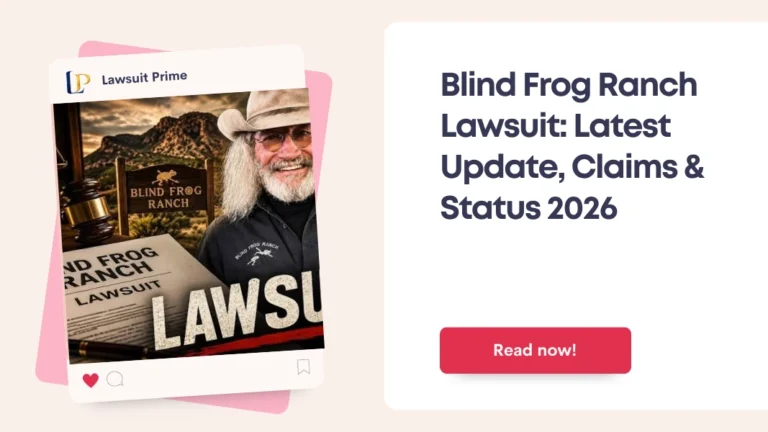

Blind Frog Ranch has attracted attention for years because of treasure stories, underground caves, unusual discoveries, and the Discovery series Mystery at Blind Frog Ranch. More recently, searches for the Blind Frog Ranch Lawsuit have grown as viewers try to determine whether disputes shown or discussed around the property developed into actual court proceedings.
Much of the confusion comes from mixing several different subjects: property and mineral-rights questions, excavation permits, environmental concerns, online allegations, and separate legal problems involving people associated with the television series. Not all of these amount to a lawsuit against Blind Frog Ranch itself.
This article separates documented information from allegations and online speculation. It examines the ranch, reported disputes, possible legal issues, the available timeline, settlement questions, and the current status as of 2026.
What Exactly Is Blind Frog Ranch?

Blind Frog Ranch is a property in northeastern Utah that became widely known through the Discovery television series Mystery at Blind Frog Ranch. The program follows efforts to investigate stories involving buried treasure, underground caverns, unusual geological formations, and unexplained phenomena.
The property is closely associated with Duane Ollinger and his family. The television series presented their attempts to explore underground areas using drilling, excavation, diving, scanning technology, and other investigative methods.
That activity is important when discussing legal questions. Owning or controlling land does not necessarily provide unlimited authority to excavate, mine, alter waterways, disturb archaeological resources, or interfere with someone else’s mineral rights.
The distinction between television storytelling and documented legal proceedings is equally important. Events described dramatically on a reality program do not necessarily establish that a lawsuit was filed or that a court reached a particular conclusion.
Location and Size
Blind Frog Ranch is generally described as being located in Utah’s Uintah Basin. The property featured on television has commonly been reported as approximately 160 acres.
The Uintah Basin has a long history involving oil, gas, mineral exploration, ranching, and stories about lost mines and buried treasure. Those overlapping interests can create complicated questions concerning surface ownership, mineral interests, access rights, and land use.
Government records also establish a historical connection between Walter Duane Ollinger and mining activity in the Deep Creek area. A Utah public notice from 2009 listed Walter Duane Ollinger and Gale R. Tipton in connection with a proposed mining operation at 10250 East 18000 North, Deep Creek.
That public notice is significant because it is an official record. It should not, however, be interpreted as proof of every lawsuit allegation later circulated online.
Ownership of Blind Frog Ranch
The television narrative has primarily associated ownership and control of Blind Frog Ranch with Duane Ollinger. Determining legal ownership in a dispute, however, can require more than identifying the person who purchased or operates a property.
A title analysis can involve deeds, co-ownership interests, mineral rights, easements, recorded claims, trusts, corporations, and other interests.
This distinction matters particularly with mining property. One person can potentially own the surface while another party possesses valid mineral or extraction rights. Whether such separate rights exist at a particular parcel must be established through deeds, recorded instruments, mining records, or court findings.
Online sources have made conflicting claims about exactly who owns which interests beneath Blind Frog Ranch. Those claims should not be treated as established legal facts without the underlying property documents.
Duane Ollinger died in June 2026 at age 68, according to multiple reports. That development may also affect future management or ownership of property interests previously held by him, depending on the title structure and estate arrangements.
Popularity Through Mystery at Blind Frog Ranch
Mystery at Blind Frog Ranch transformed what might otherwise have remained a relatively obscure Utah property into a nationally recognized location.
The series focuses heavily on alleged treasure, underground structures, strange phenomena, and the challenges encountered while exploring the land. That format naturally generates speculation about ownership, government restrictions, excavation rights, and disputes with outsiders.
Reality television also creates an important evidentiary problem for anyone researching the ranch’s legal history.
A scene involving a disagreement, government official, court visit, or excavation restriction may provide context, but television footage is not a substitute for a complaint, docket, judicial order, recorded deed, or agency enforcement document.
That difference has become central to understanding the lawsuit searches surrounding the ranch.
Why Are People Searching for the Blind Frog Ranch Lawsuit?
Interest in the Blind Frog Ranch Lawsuit appears to come from several overlapping sources rather than one easily identifiable nationwide case.
Viewers have seen or heard references to land disagreements, excavation restrictions, neighboring interests, mining rights, and other obstacles. Online articles and social-media discussions have then expanded these subjects into broader claims about litigation.
Some websites describe lawsuits involving environmental organizations, ownership questions, federal agencies, worker injuries, or intellectual property. The difficulty is that many of the most dramatic versions do not provide an independently verifiable complaint, docket number, court, or final judgment.
There are also genuine legal events involving people connected with the series that can become mixed into searches for the ranch itself. Most notably, Chad Ollinger was charged with murder after the December 2025 death of his cellmate at the Clark County Detention Center in Nevada. That criminal prosecution is separate from any property or excavation dispute involving Blind Frog Ranch.
For readers, the safest approach is therefore to distinguish four categories:
- documented government or court records;
- property and permit issues;
- allegations reported by secondary sources;
- unrelated legal proceedings involving individual cast members.
Treating all four as one “Blind Frog Ranch lawsuit” can produce a misleading picture.
Is There a Verified Blind Frog Ranch Lawsuit?
There is not enough reliable primary-source evidence available publicly to confirm the sweeping lawsuit narrative commonly repeated online under the phrase “Blind Frog Ranch lawsuit.”
This does not mean that no legal dispute involving the property, its owners, related companies, neighbors, mineral claimants, or other parties has ever existed. Rather, it means the broad version of the story should not be presented as a single verified case without identifying the actual court record.
Research into the subject has identified a genuine Uintah County public notice involving Walter Duane Ollinger and Gale R. Tipton seeking approval connected with a mining operation. The Utah Public Notice Website lists the matter among conditional-use permit applications.
By contrast, some online accounts describe environmental groups, regulators, injunctions, ownership challenges, worker lawsuits, and consolidated proceedings without supplying primary documents sufficient to verify those details independently.
One 2026 review of the available material similarly concluded that it could confirm the permit history but could not locate a verifiable case name, docket citation, filing date, or court record supporting the widely repeated environmental-lawsuit narrative.
Accordingly, readers should avoid assuming that repetition across multiple websites equals independent confirmation.
Why Blind Frog Ranch Has Faced Legal Controversy
The ranch presents several characteristics that can naturally generate legal questions: excavation, possible mineral interests, unusual land use, television production, underground exploration, and potentially dangerous physical activity.
Those circumstances create legal exposure even when they do not result in litigation.
A landowner conducting excavation, for example, may encounter zoning rules, environmental regulations, permitting requirements, mineral-rights disputes, workplace safety obligations, or contractual disagreements.
The important question is whether a particular concern became an actual legal claim.
Ownership and Property Disputes
Property ownership is more complicated than simply determining who occupies or purchased a parcel.
A legal dispute can arise when neighboring owners disagree about boundaries, when recorded descriptions overlap, when another party asserts an easement, or when surface and mineral interests are separately held.
Mining properties can be particularly complicated because historical claims and conveyances may have created rights that are not immediately obvious from physical possession.
Online discussions concerning Blind Frog Ranch have included assertions about mineral rights and competing ownership interests. Some users have even referenced a purported Utah case number, but community posts themselves are not reliable proof of what a court has ruled.
A credible legal analysis would require the actual pleadings, deeds, title records, or judicial orders before stating that any particular claimant prevailed.
Environmental and Excavation Concerns
Excavation is another major source of speculation.
Ownership of land generally does not exempt an owner from zoning, environmental, mining, water, or excavation regulations. Depending on the activity, approvals may be required at county, state, or federal levels.
There is concrete evidence that mining-related permitting was relevant to Ollinger long before the television series became popular. The 2009 Uintah County public notice specifically identifies Walter Duane Ollinger and Gale R. Tipton in connection with a mining operation in Deep Creek.
That record supports the conclusion that land-use regulation has been relevant to activities associated with Ollinger.
It does not, standing alone, prove claims that environmental agencies later sued Blind Frog Ranch, obtained an injunction, or successfully stopped excavation.
Safety and Liability Concerns
The exploration shown on Mystery at Blind Frog Ranch involves potentially hazardous activities, including drilling, underground access, diving, heavy equipment, and work around unstable terrain.
Such activities can create liability concerns.
If a worker, contractor, visitor, or participant were injured, potential legal questions could involve negligence, premises liability, assumption of risk, contractual indemnification, workers’ compensation, or occupational safety requirements.
The existence of hazardous activity, however, does not prove that a particular personal-injury lawsuit was filed.
Some secondary articles claim that workers brought liability allegations connected to the ranch. Without a clearly identifiable complaint or court docket supporting those claims, they should remain characterized as unverified rather than established litigation.
Commercialization and Intellectual Property Issues
A successful reality television property can generate substantial commercial value.
Possible intellectual-property disputes could involve trademarks, footage, production agreements, merchandising, branding, story concepts, licensing, or ownership of creative materials.
Contract disputes could also arise among producers, participants, investors, or business partners.
Again, these are legally plausible categories rather than proof that a specific lawsuit exists.
Any claim that a former partner or participant successfully sued over Mystery at Blind Frog Ranch should be supported by identifiable court documents before being reported as fact.
Core Allegations Connected to the Blind Frog Ranch Lawsuit
Online discussions of the Blind Frog Ranch Lawsuit generally revolve around four themes: property ownership, environmental compliance, safety, and commercial rights.
The strength of the evidence varies considerably.
| Issue | Current Evidentiary Position |
|---|---|
| Mining/permit activity | Historical government record confirmed |
| Ownership or mineral-rights disagreement | Discussed publicly; exact scope requires primary records |
| Environmental lawsuit | Broad online claims not independently established |
| Worker liability lawsuit | Reported by some secondary sources but requires docket verification |
| Intellectual-property litigation | Claims circulate online; primary documentation is needed |
| Settlement | No broadly verified settlement identified |
The distinction matters because an allegation can sound credible while remaining legally unproven.
Ownership and Boundary Conflicts
Reported ownership controversies concern who controls the land and, potentially, who controls resources beneath it.
Surface title and mineral rights are not necessarily identical. Mineral interests may sometimes be severed from surface ownership, meaning different parties possess different legal interests in the same geographic area.
Boundary disputes can likewise depend on surveys, recorded legal descriptions, historical deeds, easements, and prior judicial decisions.
For Blind Frog Ranch, online commenters and secondary publications have offered conflicting versions of these issues.
Without reviewing authenticated title documents and court pleadings, it would be premature to state that a court has definitively found Duane Ollinger or another party lacked ownership rights.
Environmental and Archaeological Issues
Treasure hunting and excavation can raise additional concerns if activity affects protected resources.
Depending on the location and circumstances, environmental review may involve soil disturbance, waterways, waste, hazardous substances, reclamation, or mining regulations.
Archaeological discoveries can introduce a separate set of legal questions. The treatment of cultural materials can depend on where they are found, who owns the land, whether federal or tribal interests are implicated, and what type of resource is involved.
Online claims sometimes suggest that Blind Frog Ranch excavation triggered extensive environmental enforcement.
Those statements require caution. A permit issue or regulatory inquiry is not automatically an environmental lawsuit, and neither establishes wrongdoing unless supported by the relevant agency or court record.
Worker Safety and Liability
Underground exploration carries obvious physical risks.
If an accident occurred because of allegedly unsafe equipment, inadequate training, dangerous premises, or negligent supervision, an injured person could potentially seek compensation.
The claimant would ordinarily need to establish the applicable duty of care, a breach of that duty, causation, and legally recognized damages.
Defendants might raise defenses involving comparative fault, contractual allocation of risk, workers’ compensation exclusivity, or other state-law protections.
This framework explains why safety questions surrounding the ranch are legally relevant. It should not be confused with confirmation that a specific worker has successfully established liability against the ranch.
Intellectual Property and Media Rights
Reality television involves multiple layers of commercial agreements.
Production companies, broadcasters, cast members, consultants, photographers, and business partners may possess different contractual or intellectual-property rights.
Disputes could theoretically involve ownership of footage, compensation, confidentiality, trademarks, licensing, or representations concerning creative contributions.
These issues are different from land or mining disputes.
For that reason, any intellectual-property claim associated with Blind Frog Ranch should be analyzed separately rather than grouped automatically into one supposed lawsuit.
Blind Frog Ranch Lawsuit Timeline
A timeline helps explain why online discussions can be confusing. Several events relate to the ranch, while others concern individual cast members or older permitting matters.
The following chronology distinguishes those categories.
Developments in 2021
Mystery at Blind Frog Ranch began airing in 2021, bringing national attention to Duane Ollinger’s treasure-hunting activities.
The television series introduced viewers to excavation, underground exploration, property questions, and unusual incidents around the ranch.
As public interest increased, viewers began discussing whether obstacles portrayed on the program reflected actual regulatory or court disputes.
However, the start of the television series should not itself be treated as the beginning of a verified lawsuit.
Developments in 2022
By 2022, discussion around the program increasingly included skepticism, land questions, and speculation about whether excavation could legally continue.
Online communities debated the authenticity of events portrayed on television and questioned whether regulatory or property disputes existed outside the program.
Such discussions are useful for understanding search interest but are not reliable legal evidence.
A genuine lawsuit filed during this period would ordinarily be verified through a court name, parties, complaint, case number, filing date, and subsequent docket activity.
Developments in 2023
Online discussion of possible court proceedings continued during 2023.
Some viewers specifically asked whether a proceeding referenced on the show could be found in Utah’s public court system. Other users claimed mineral-rights litigation existed, although the discussions relied heavily on screenshots and secondhand statements rather than independently accessible court documents.
That illustrates the core research problem.
There may be underlying disputes or filings, but a social-media description of a document should not be treated as equivalent to reviewing the authenticated record itself.
Developments in 2024
Claims about property rights and litigation continued circulating online in 2024.
Some later commenters alleged that posts or documents from this period concerned mineral-rights claims against Ollinger. Those statements remain difficult to evaluate without the complete underlying pleadings and docket history.
Separately, Chad Ollinger encountered legal problems unrelated to any Blind Frog Ranch property lawsuit.
Reports concerning his later criminal case state that he had been arrested in November 2024 after allegedly fleeing police on a motorcycle.
That matter should not be represented as part of litigation over ranch ownership or excavation.
Developments in 2025
During 2025, online articles increasingly used phrases such as “Blind Frog Ranch lawsuit update,” causing various legal narratives to become blended together.
Some described environmental and property disputes as established litigation. Others questioned whether sufficient primary documentation existed to substantiate those accounts.
A September 2025 legal-information review found the historical mining-permit record but reported that it could not independently locate the case number, court, or filing date supporting the widely repeated environmental-lawsuit story.
A major separate development occurred in December 2025.
Chad Ollinger was charged with murder following the death of his cellmate at the Clark County Detention Center in Las Vegas. Authorities alleged that a physical altercation occurred before the victim was found with apparent blunt-force injuries. The charge is a criminal allegation and does not establish guilt.
Latest Developments in 2026
The most significant confirmed developments in 2026 concern the people associated with the program rather than a clearly established ranch-wide civil lawsuit.
Duane Ollinger died in June 2026 at age 68. Entertainment Weekly reported that he had been battling ALS and that Mystery at Blind Frog Ranch had continued into a sixth season.
Chad Ollinger’s Nevada criminal case is a separate proceeding and should not be merged with claims concerning Utah property rights, environmental regulation, or excavation.
Meanwhile, online sources continue to publish conflicting descriptions of supposed ranch litigation.
As of August 2026, readers should therefore distinguish confirmed developments from secondary claims for which an underlying docket, complaint, judgment, or settlement agreement has not been independently established.
Blind Frog Ranch Lawsuit Update 2026
The central 2026 update is straightforward: there remains substantial online discussion about legal disputes connected to Blind Frog Ranch, but the broad lawsuit narrative often presented online is not supported by sufficiently accessible primary documentation to safely describe every alleged claim as established fact.
What can be confirmed is narrower.
Walter Duane Ollinger appears in an official Utah public notice concerning a mining-operation conditional-use permit dating to 2009. The ranch subsequently became nationally known through Mystery at Blind Frog Ranch.
Duane died in June 2026. His death could potentially create estate or ownership questions depending on how relevant property interests were titled, although it does not itself establish a lawsuit.
Chad Ollinger also faces a serious but separate criminal prosecution in Nevada stemming from the December 2025 death of his jail cellmate.
Readers searching specifically for a 2026 settlement, payout, class-action claim form, or final judgment concerning a general Blind Frog Ranch civil lawsuit should be cautious. No broadly verified settlement matching that description has been established through the sources reviewed for this article.
What Do Public Records Show About Blind Frog Ranch Legal Disputes?
Public records provide a narrower picture than many online summaries.
The clearest government document identified during research is a Utah Public Notice Website record for Uintah County. It lists “Walter Duane Ollinger & Gale R Tipton” in connection with a mining operation at 10250 East 18000 North, Deep Creek.
That establishes an official permitting history.
It does not establish that a court later found Ollinger liable for environmental violations, that federal authorities claimed ownership of the ranch, or that an environmental coalition obtained an injunction.
Utah maintains official court resources through the Utah State Courts system. Anyone attempting to establish the status of a specific state lawsuit should ideally locate the case through official court records and verify the named parties, case number, filing date, claims, orders, and disposition.
This approach is particularly important because secondary sources conflict sharply.
When a dramatic legal assertion appears online without a docket or primary document, it should be characterized as unverified rather than repeated as a judicial finding.
Legal Issues That Could Apply to Blind Frog Ranch Disputes
Several areas of law could apply to disputes involving a property such as Blind Frog Ranch.
Which laws actually govern depends on the facts.
Ownership disputes are primarily concerned with title and property rights. Mining or excavation activity can involve local permitting and state or federal regulation. Injuries can trigger tort or workplace law. Television commercialization can raise contract and intellectual-property questions.
These areas should not be blended together merely because they concern the same property.
Property and Boundary Law
Property law determines who holds legally enforceable interests in land.
Relevant evidence can include deeds, surveys, title records, easements, recorded liens, mineral reservations, and historical conveyances.
If two parties disagree about a boundary, litigation might seek to quiet title or establish the proper property line.
Mineral ownership creates additional complexity. A person possessing surface rights may not necessarily possess every mineral interest underneath the land.
A court considering such a dispute would rely on legal documents and applicable property law rather than the way ownership is portrayed on television.
Environmental Regulations
Environmental regulation can limit what landowners may do even on privately owned property.
Mining and excavation activities can potentially implicate rules concerning waste, water, soil disturbance, hazardous substances, reclamation, and environmental protection.
Which agency has jurisdiction depends on the activity and location.
The existence of regulation should not be confused with proof of a violation. Regulators generally must establish that a particular legal requirement applies and that the regulated party failed to comply with it before penalties or other remedies can be imposed.
Excavation and Land-Use Rules
Counties commonly regulate land uses through zoning and conditional-use permits.
The historical Uintah County notice involving Ollinger demonstrates why this area of law is directly relevant. The public notice placed his proposed mining operation within a governmental approval process.
A conditional-use permit allows local authorities to evaluate whether a proposed use satisfies applicable standards.
Depending on local rules, officials may impose conditions addressing safety, traffic, environmental effects, noise, restoration, or neighboring properties.
Violation of those conditions can potentially lead to administrative enforcement or litigation, but enforcement must be established from the actual record.
Premises and Worker Liability
Landowners and businesses may owe legal duties to people working on or visiting their property.
If someone is injured, the applicable standard can depend on why that person was present, whether the danger was known, what warnings were given, and whether employment or contractor relationships existed.
In a high-risk environment involving caves, drilling, machinery, or diving, safety practices can become particularly significant.
Nevertheless, an accident alone does not establish negligence.
A plaintiff generally must prove the elements required by the applicable law, including causation and damages.
Intellectual Property Rights
Television projects can involve copyrights, trademarks, publicity rights, licensing agreements, and contractual ownership provisions.
For example, rights to recorded footage may belong to a production company under contractual arrangements rather than to the individuals appearing on screen.
Names and branding can create trademark questions.
Creative contributors may also dispute compensation or ownership depending on their agreements.
These issues require examination of the relevant contracts and registrations. Public speculation about who “created” an idea is rarely sufficient to establish an intellectual-property violation.
Has There Been a Blind Frog Ranch Lawsuit Settlement?
No broadly verified settlement has been identified for the generalized Blind Frog Ranch Lawsuit commonly described in online searches.
That means readers should be skeptical of claims suggesting that a universal settlement fund, payout program, or compensation process exists unless those claims identify an actual case and authoritative settlement documentation.
A legitimate civil settlement normally provides identifiable information such as:
- the parties involved;
- the court and case number, if litigation was filed;
- claims being resolved;
- settlement terms or a court approval process where applicable;
- relevant deadlines;
- eligibility requirements if compensation extends to a class.
None of those elements should be invented simply because users frequently search for “Blind Frog Ranch lawsuit settlement.”
Private settlements can sometimes remain confidential. But the absence of publicly available details does not justify claiming that a settlement occurred.
As of the current 2026 review, there is no verified basis for telling viewers, consumers, or members of the public that they can file a compensation claim connected with a general Blind Frog Ranch settlement.
What Was the Outcome of the Blind Frog Ranch Lawsuit?
There is no single verified outcome that can accurately be assigned to everything described online as the Blind Frog Ranch Lawsuit.
That is because the term appears to combine different issues rather than consistently referring to one clearly documented case.
Permit questions, possible mineral-rights disputes, alleged environmental concerns, television-related issues, and individual criminal proceedings are legally distinct.
A court ruling in one matter would not resolve all of the others.
Therefore, claims that “Blind Frog Ranch won the lawsuit” or “the ranch lost the lawsuit” should be approached cautiously unless the statement identifies the parties, court, case number, and ruling.
The safest current conclusion is that no universal final judgment or settlement resolving the broad collection of allegations has been independently established.
Where a specific case can be identified, its outcome should be evaluated from the corresponding docket and judicial orders rather than from generalized online summaries.
Did the Lawsuit Affect Mystery at Blind Frog Ranch?
There is no verified evidence showing that a generalized Blind Frog Ranch civil lawsuit caused Mystery at Blind Frog Ranch to end.
In fact, the program continued beyond its earlier seasons.
Entertainment Weekly reported in June 2026 that the show had reached Season 6 and that treasure hunter Josh Feldman had taken over the investigation after Duane Ollinger’s health declined.
Duane’s death and Chad Ollinger’s separate criminal proceedings represent substantial changes involving figures closely associated with the series.
Those events may affect production decisions independently of any property litigation.
Production schedules can also change for numerous reasons, including ratings, contracts, cast availability, network strategy, health, logistics, and access to filming locations.
Without an official statement linking a particular legal dispute to a production decision, it would be speculative to attribute changes in the show directly to a lawsuit.
How Legal Controversies Could Affect Blind Frog Ranch
Legal uncertainty can have practical consequences even before a court reaches a final decision.
A genuine property dispute, for example, could complicate financing, sale negotiations, excavation plans, or investment. A dispute over mineral rights could affect who has authority to extract resources.
Permitting problems could delay particular operations.
Liability concerns might lead to stricter safety procedures, insurance requirements, or limitations on access.
Commercial disputes could influence branding, licensing, or television contracts.
Duane Ollinger’s death introduces another potential layer of complexity. Depending on how his interests were held, ownership or management could pass through probate, survivorship arrangements, trusts, companies, or other estate-planning mechanisms.
Those possibilities should not be reported as established outcomes without the relevant estate and title records.
Legal controversy therefore matters to the ranch, but “could affect” is different from saying that a court has already imposed a specific restriction.
How to Separate Verified Legal Facts From Online Rumors
The Blind Frog Ranch story demonstrates why source verification matters in legal reporting.
Search results can make an allegation appear well established when multiple websites repeat the same original claim. If those sites ultimately rely on one unsourced article, however, they do not represent multiple independent confirmations.
Readers can use a simple verification process:
- Look for the full names of the plaintiff and defendant.
- Identify the court handling the case.
- Find the docket or case number.
- Check the filing date.
- Locate the complaint or judicial order.
- Distinguish allegations from findings.
- Verify settlement claims through court or official settlement documents.
Official government records generally carry more evidentiary weight than blogs, entertainment summaries, or social-media discussions.
For Blind Frog Ranch, the Utah public notice involving Ollinger is an example of verifiable primary-source information.
By contrast, a Reddit discussion referring to a supposed case or screenshot can provide a research lead, but it should not be presented as proof of a court’s decision.
Current Status of the Blind Frog Ranch Lawsuit
As of August 2026, the phrase Blind Frog Ranch Lawsuit remains broader than the verified legal record available from readily accessible sources.
There is documented evidence of historical mining-permit activity involving Walter Duane Ollinger. There have also been public discussions about property and mineral rights, environmental concerns, and other potential disputes.
However, the sweeping narrative describing one consolidated lawsuit involving all of these allegations should not be stated as fact without the underlying court records.
No broadly verified final settlement, universal payout, class-action claim process, or comprehensive judgment has been established for the generalized lawsuit narrative.
Two major 2026 developments should also be kept separate from that question. Duane Ollinger died in June 2026, while Chad Ollinger faces a separate Nevada criminal prosecution stemming from his cellmate’s death in December 2025.
Anyone researching a specific property dispute should rely on Utah court records, county land and permit records, and authenticated filings rather than summaries that do not identify their primary sources.
Read: Symmetry Financial Group Lawsuit
Read: Zoloft While Breastfeeding Lawsuit
Read: Vegamour Lawsuit
Read: Dwayne Johnson Energy Drink Lawsuit
Read: Cash App Class Action Lawsuit Settlement
Read: Chobani Yogurt Lawsuit
Read: Life360 Lawsuit 2026
Read: Isotonix Lawsuit
Frequently Asked Questions
Is there really a Blind Frog Ranch lawsuit?
Legal disputes have been discussed, but many online claims about a single major lawsuit remain unverified.
What is the Blind Frog Ranch lawsuit about?
Reports mainly involve property rights, mineral interests, excavation, environmental concerns, and related legal questions.
Who owns Blind Frog Ranch now?
Duane Ollinger was closely associated with ownership. After his 2026 death, current ownership depends on applicable property and estate records.
Was Blind Frog Ranch stopped from excavating?
Mining and excavation can require permits, but claims of a sweeping court order stopping all excavation have not been clearly verified.
Is Chad Ollinger’s criminal case related to the ranch lawsuit?
No. His Nevada criminal case is separate from reported property or excavation disputes involving Blind Frog Ranch.
Is there a Blind Frog Ranch settlement payout?
No verified class-action payout or public compensation program has been confirmed.
Where can I check the lawsuit status?
Check official Utah court records, county property records, and government filings for the most reliable information.
The Blind Frog Ranch Lawsuit remains a good example of how reality television, genuine regulatory records, possible private disputes, and internet speculation can become blended into one legal narrative.
Confirmed information shows that Walter Duane Ollinger was involved in a historical Uintah County mining-permit process, while later public discussion has raised questions about property interests, excavation, environmental regulation, and other disputes. But many of the strongest claims circulating online lack the primary court documentation needed to report them as established facts.
The situation also changed significantly in 2026 following Duane Ollinger’s death, while Chad Ollinger’s separate Nevada criminal case continues to generate attention around the family.
Readers should rely on current court dockets, recorded property documents, government permit records, and official agency statements when evaluating future developments. Allegations remain allegations unless supported by evidence and resolved through the appropriate legal process.
Disclaimer: This article is for general informational purposes only and does not constitute legal advice. Court proceedings, property records, and case statuses can change. Anyone directly involved in a legal dispute should consult a qualified attorney.